
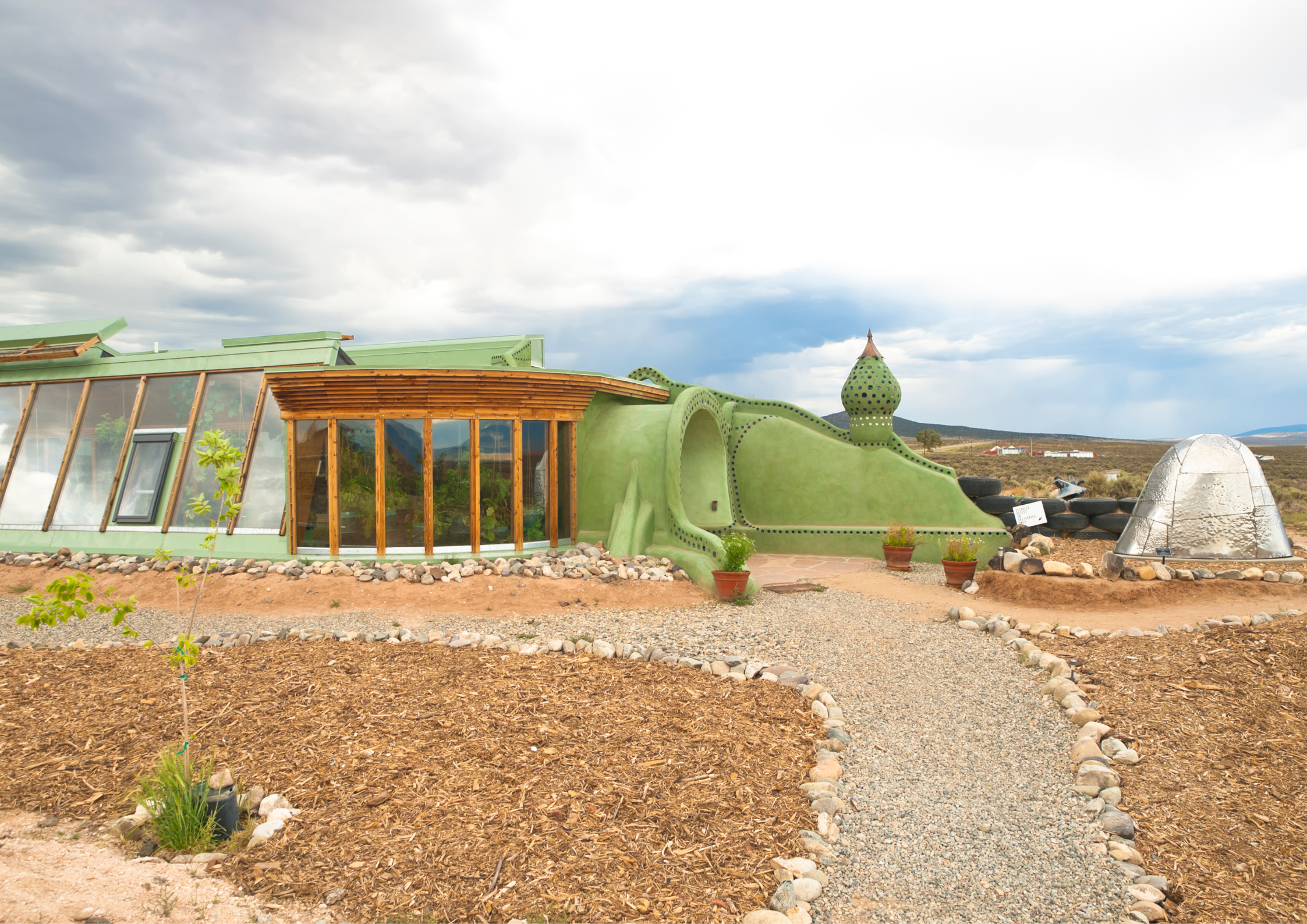
In my last article about Earthships, I discussed the architect Michael Reyold and how his vision for a sustainable house got him to collect as many discarded materials as he could see lying around and build an Earthship. In this article, I will explain the design principles of an Earthship in depth and how they might convince you to make your house just like he did.

Figure 1: Earthship built at Taos, New Mexico⁽¹⁾.
Michael Reynold’s design principles for this Earthship
An Earthship is designed with these six elements, which provide a comfortable indoor temperature without the use of an HVAC system, which means no ACs or heaters to cool or warm the space.
Passive Solar Heating and Cooling
Passive heating and cooling (1) is the concept of utilising the sun’s energy to warm the interiors of a house. While building an Earthship, one side of the house (south or north, depending on the hemisphere) is fixed with windows to allow the sun’s heat into the house. And the walls and floors of the Earthship are made from earthy materials that store the sun’s heat. Earth-type materials such as stone and mud can hold temperatures like a battery stores energy (2). The solar heat entering the house is easily absorbed by earthy materials like stone, mud, or earth; hence, Earthships are primarily made of ‘rammed earth in recycled tyres’. When the sun goes away at night, the stored heat within these walls transfers into the room space. This release of heat energy helps the house remain warm, especially when the outdoors is excessively cold. Passive heating-cooling helps reduce the dependence on an external heating source, like your heaters or fireplaces.
High thermal mass materials are beneficial for tapping into the sun’s heat and letting it stay indoors during the cold nights (3). However in tropical places like India, low thermal mass materials are preferred. TropoMod is another kind of earthship concept developed in Australia, which uses low thermal mass materials and the effect of ventilation to ensure that the country’s tropical heat is not built up inside nor gets stored in the walls or floors of the building (4).
Cooling tubes bring air into the building to keep the Earthship cool. An earthship is also interfaced with the earth, and there is no insulation between the earth and the building floor, helping to remain cool.

Figure 2: Large windows on one wall designed to let in solar energy, thus naturally heating the house⁽²⁾.
Use of renewable energy
An Earthship traditionally uses 25% less electricity than a conventional house since it uses passive heating and cooling instead of an HVAC system. For all its additional needs, it is connected to solar panels and may even be connected to wind turbine energy systems in places with great wind speeds (5).
On-site Sewage Treatment
An Earthship is an off-grid building, even to the point of treating its sewage waste. The water systems used inside an Earthship are treated and differentiated as grey, black, and drinking water. Grey water, the wastewater from the shower, sink, and laundry, is then sent to what they term ‘Grey water cells’, where specific plants whose roots filter the water are planted. This procedure is similar to how a wetland behaves. This filtered water is then reused to flush the toilets only.
The black water, on the other hand, the water from the toilet, goes to the ‘Septic tank system’, where the tank is lined with rubber material and also filled with many such rubber tyres. The tank is designed to separate the liquid from the solid waste, and the liquid waste goes into the next cell, the ‘botanical cell’. The following image will help understand this system:

Figure 3: Greywater treatment system in an off-grid house like Earthship⁽⁶⁾.
Natural and Recycled Materials
As we all know, an Earthship is famous for using its recycled materials. The recycled tyre rammed into the earth, is like a perfect thermal material that serves as a good wall and an excellent thermal material. Other recycled materials like bottles, metal, reclaimed wood and natural materials like mud are used in the building process. Michael also promotes using upcycled materials to give the house your personality and decorate the interiors.

Figure 4: A worker constructing the Earthship, image showing the use of earth rammed tyre, as the building block of an earthship⁽¹⁾.
Water Harvesting
For water usage, the Earthship is built with a cool rainwater harvesting feature, where it collects the water in cisterns or tanks, and the water is pumped through a water filtration system, which makes it safe for drinking, cooking, laundry and showering.
Food production
An Earthship should also grow its food to be completely sustainable. Hydroponically grown plants are selected and kept inside a greenhouse. These plants are also vital as they play the role of filtering grey water.
Would I live in an Earthship?
I may consider an Earthship because of its unique sustainability feature. It is less dependent on external power connections and has less carbon footprint to build and run. Surrounded by greenery and natural heating and cooling, this house will also have excellent psychological benefits.
However, there could be specific challenges while constructing one. Building an earthship is typically more expensive because of the high labour cost involved compared to conventional building, but it will be economical in the long run. It will also take a longer time to finish building as well.
Looking at the design aspect and the design principle, I would consider building an earthship with an emergency connection with the grid. In case something fails, and as a backup, a connection to the grid would be helpful.
What are the long-term impacts of staying on an Earthship? Is it reliable in times of emergencies like earthquakes or floods? What if my place does not get any rainfall? Well, these and many other factors are yet to be considered when choosing an Earthship.
At ecoHQ, we will discuss these in the upcoming articles.
References
- What are earthships? And are they the future of Sustainable Living? House and Garden, https://www.houseandgarden.co.uk/article/earthships-sustainable-living, March 2022
- Earthship Homes: Are They the Next Big Sustainable Housing Trend?, Jenn Ryan, https://www.bobvila.com/articles/earthship-homes/ July 28 2022.
- Sustainable Construction, What is Thermal Mass?https://www.hockertonhousingproject.org.uk/2021/04/sustainable-construction-what-is-thermal-mass/
- TropoMod-Tropical Modular Earthship, https://www.earthshipecohomes.com.au/tropomod.html,
- Earthship System and Design Principles, https://earthship.com/systems/
- What is a grey water system?, Eco build houses, https://www.ecobuildlab.com/things-to-consider-if-your-are-considering-a-greywater-system, Jan 2021.
Credits
The article was authored by Jenifer F Dsouza, an environmental consultant with an M.S. degree from The University of Manchester, U.K. She has over seven years of experience in water technologies and is an ESG consultant. She advocates for environmental consciousness and is a content and technical writer for ecological issues. She has authored 11 peer-reviewed journals during her academic research with collaborative projects with MIT University, Boston.
The article was conceptualised and strategised by Deepa Sai, founder of ecoHQ
One response to “Design Principles of an Earthship: A Sustainable Housing Idea”
[…] Passive heating and cooling is a concept that utilises the sun’s energy to warm the interiors of a house. One side of the structure (usually south or north, depending on the hemisphere the house is located in) is fixed with large-sized windows to allow sunrays into the house. The earthship’s walls and floors are made from earthy materials (or materials that store the sun’s heat, such as stone and mud). Such earthy materials easily absorb the sun’s heat, which is why the primary building block in these earthships consists of “rammed earth in recycled tires”. […]