

At ecoHQ, we have been posting articles on developing a sustainability strategy for companies (designing, executing, measuring, reporting, and monitoring goals). We are now discussing circularity and regenerative strategies.
So far, we have discussed the following in the previous pieces:
- Redesigning business models based on company values, Benchmarking and Setting ESG targets
- GHG accounting, Risk Analysis, Scenario Planning as well as Reporting and Disclosures
- Decarbonisation strategy (focusing on abatement, avoidance, offsets, insetting, and removal), climate transition strategy, and emission reduction roadmap
- ESG Roadmap to Net Zero, Carbon market pathway to net zero (with a special focus on the carbon market ecosystem).
- Comprehensive ESG Implementation.
This article will tell you how to craft a circularity strategy for your organisation, and the following article will touch on building a regenerative strategy for your venture.
We are in an era of scrambling to develop communities and economies while heavily depending on depleting finite natural resources, and geopolitical tensions are rampant.
We need more conscious entrepreneurs who think about the people, planet, and profits (triple bottom line) and ensure they build a financially viable, resilient, equitable, and sustainable future.
It is increasingly imperative that businesses consider and actively invest in environmental protection to survive. They must transition from the ”take-make-waste” model to circular (borrow-use-return) and regenerative (borrow-use-restore) models.
A proper circularity strategy would impact your organisation at various levels: it would save costs, enhance your brand reputation, minimise the need for virgin resources and waste, and avoid penalisation by adhering to multiple regulations and compliances.
Here, I would like to explain the difference between circularity and circular economy. Circularity may mean engaging in practices where we design solutions with minimal wastage, keep materials in use/circulation and out of landfills for the longest time possible and regenerate ecosystems through product/solution use and discard.
Circular economy models integrate circularity principles into business strategies, operations, policies, and markets to derive strategic and financial returns.

We have succinctly put down the various steps involved comprehensively, though not exhaustive:
Audit the existing state of the company.
- Conduct a comprehensive baseline assessment of resource use, waste generation, and supply chain impact. What areas or operations are where most of your resources are used and wasted? Are there any inefficiencies in your supply chain? Figure out the opportunities for redesigning the process or product.
- Here, Life Cycle Assessments (LCA) and material flow analyses along with circularity assessment frameworks like the Circularity Gap Report, Material Circularity Indicator (MCI), Ellen MacArthur Foundation’sFoundation’s Circulytics and Cradle to Cradle Certified™ will be helpful.
- Others to consider are the Circularity Assessment Protocol (CAP), Circular Material Assessment, ResCoM Circularity Framework, ISO 14040/44 Life Cycle Assessment, and Circular Transition Indicators (CTI).
Goals and Metrics
- Define and develop your measurable goals and objectives in alignment with global frameworks and regulations, such as the UN Sustainable Development Goals (SDGs), Extended Producer Responsibility (EPR) regulations, or Science-Based Targets (SBTs).
- Your metrics could be resource efficiency improvements, waste reduction targets or the percentage of recycled content used in products.
Service and Product Redesign
- A good start would be to infuse circularity principles while designing or redesigning products, focusing on modular, recyclable, repairable, and durable products. You can use the principles of green chemistry and green engineering to guide you.
- Apart from that, you can look at service-based models like product as a service (especially leasing or renting instead of selling), which can delay the end of a product’s life and extend its lifespan.


Also, check out our comprehensive article on Green Engineering:
Waste Management solutions
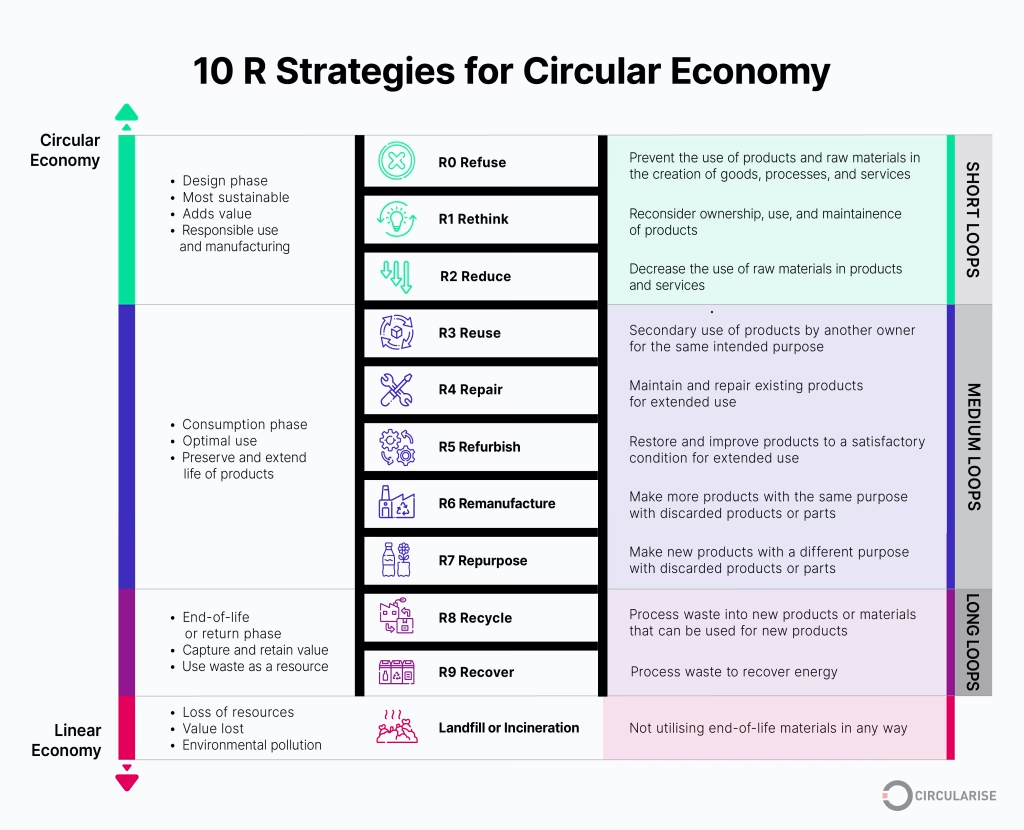
- Adopt sources such as source segregation, upcycling, recycling, repairing, or partnering with niche firms to design material recovery solutions. You could also look at the circular economy’s 10R strategies.
- Innovative and tech-based solutions like AI-powered waste sorting, chemical or chemo-mechanical recycling and bio-based solutions are now available.
- While the above will address some of the waste management lifecycles of products, you must develop closed-loop logistics (like reverse logistics services: takeback systems, repair, refurbishment, and selling in secondary markets like thrifting, pre-loved, collectables, auctions, etc.).
- You could address the problem at its root by sourcing sustainable, recycled, or regenerative materials from secondary material markets.
- The above could be monitored and tracked using AI and blockchain technologies and standardised in-house protocols for waste collection, sorting, storage, packing, etc.
Supply-chain transparency and traceability
- AI, IoT, and blockchain could be leveraged from ethical material sourcing to the product’s end-of-life—so consumers can make context-based, informed decisions.
- Use such tracked data for predictive maintenance, energy efficiency, lean operations, resource optimisation, and sustainable product design.
- Designing tech platforms that track reverse logistics and enable product takeback, sharing, reuse, and resale would foster conscious and mindful product use and circularity.
- Using such data-centric procedures, obtain relevant certifications like the Global Recycle Standard (GRS), EU Ecolabel, Cradle to Cradle Certified (C2C), B Corporation Certification, ISO 14001 Environmental Management System, Blauer Engel, and LEED.
- Emerging innovations like 3D printing and biodegradable packaging minimise waste and energy.
Organisational and Product Assessments
- While doing the environmental assessment of your venture and your products, consider not just upstream (cradle-to-gate) but also downstream impacts —(cradle-to-grave like recycling, landfill or incineration) and especially the end-of-life of the product (cradle-to-cradle, like fully reclaimed, biodegraded, composted, or upcycled or regenerated).
- Conduct circularity material assessments using tools like Circularity Assessment Protocols (CAP) to measure impact.
- While focusing on environmental LCA (E-LCA), look at a product’s social LCA (S-LCA). S-LCA assesses a product’s social and socio-economic implicit throughout its lifecycle, focusing on stakeholders such as employees and communities. It evaluates human and labour rights, working conditions, and community well-being to supplement environmental assessments, ensuring ethical and sustainable practices are followed across the value chain.


Strategic Partnerships and Coalition Building
- Stakeholder buy-in is essential to the circularity strategy, as we need collaboration across the value chain—suppliers, employees, customers, policymakers, investors, and more. Develop training, awareness programs, and incentive-based initiatives to build a circular culture in the company and its associated value chain.
- Develop strategic partnerships with vendors, consultants and service providers specialising in circularity, carbon consulting, waste management, ESG and impact communication consultants like ecoHQ.
- Build industry coalitions to promote fair trade and responsible manufacturing strategies.

Leveraging Circularity for Credits and Compliance
- Companies can earn plastic credits, carbon credits, water credits, renewable energy certificates (RECs), biodiversity credits, and green credits (India) by following circular strategies that enhance resource recovery and optimal or reduced resource consumption.
- Several corporates with Extended Producer Responsibility (EPR) mandates are accountable for handling post-consumer waste. They are also responsible for GHG footprint disclosure, waste tracking, recycled content requirements, and sustainable packaging mandates, as required by specific regulations, like the Corporate Sustainability Due Diligence Directive (CSDDD) and Europe’s Carbon Border Adjustment Mechanism (EU CBAM).
- You can generate carbon credits through mechanisms like biochar production, waste to energy, landfill gas capture, renewable energy use, energy efficiency, industrial emission reduction, etc., enabling you to gain extra revenue through your sustainability efforts.

Monitor, Evaluate, and Scale
- Using data-driven insights, you can regularly track the progress of your circularity efforts and adjust your strategies based on stakeholder feedback, metrics, performance, and evolving market and industry dynamics to scale effectively.
- Sustainability reporting like GRI or TCFD helps you disclose your initiatives and impact to various stakeholders.
- Create playbooks and manuals along with your company’scompany’s circularity policies and guidelines to improve continuously.
The upcoming article will examine incorporating regenerative strategies into organisational policies and procedures.
Credits
This article is written by Deepa Sai, the founder of ecoHQ
Sources
https://www.circularise.com/blogs/r-strategies-for-a-circular-economy –
Other studies from Terra.do, OnePointFive Academy and Climatebase
[…] Check out the Circularity Strategies We’ve Published […]
[…] As I noted in my article on Circularity Strategy: […]
[…] Crafting a Circularity Strategy for your organisation – Part 6 […]
[…] when I wrote my earlier piece on building a circularity strategy in 2025, I was already looking at many of these pieces separately: product redesign, repairability, […]