

At ecoHQ, we have been posting articles on developing a sustainability strategy for companies (designing, executing, measuring, reporting, and monitoring goals).
The first article discussed how an organisation can set purpose and values, redesign the business model, benchmark itself among peers in the industry, and set short-term and long-term Environmental, Social, and Governance (ESG) targets.
The second article discussed how the organisation can execute Greenhouse Gas (GHG) accounting and conduct risk analysis and scenario planning analysis to be resilient for the future. At the same time, the company would also conduct socio-ecological and climate modelling to understand its double materiality impacts. Then, the company chooses various ESG frameworks for disclosures and sustainability reporting.
The third article discussed the climate transition strategy and emission reduction roadmap, focusing on implementation.
The Fourth article will discuss the company’s ESG implementation and crafting a pathway to net zero, including a carbon market pathway.
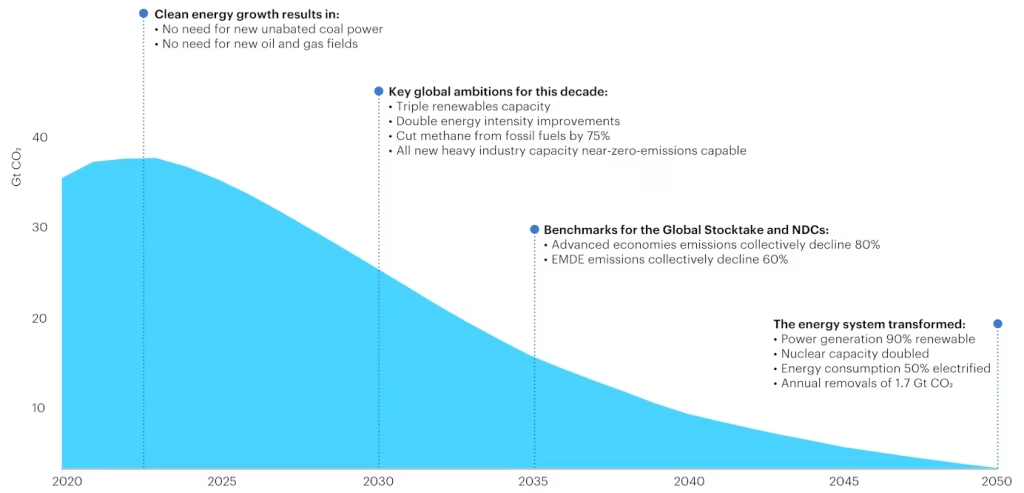
Crafting an overarching ESG roadmap to Net Zero
Here is a recommended best-practices guideline (comprehensive but not exhaustive) to follow to create a net-zero trajectory roadmap:
2020–2030 (Setting the foundation and initial decarbonisation)
- Governance & Target Setting (with the management support and sponsorship, set up a dedicated ESG/ Sustainability team)
- Use the GHG-Protocol for a comprehensive GHG inventory (Scopes 1, 2, 3)
- Set Science-Based Targets (SBTs) — short-term (2030) and long-term (2050) — aligned with the 1.5°C pathway, validated by SBTi.
- Include climate targets in budgeting, business strategy, and performance management.
- Do an ESG Gap analysis and create an ESG roadmap for your organisation in alignment with frameworks like ESRS, BRSR, IFRS S1 & S. Consider the Sustainability Accounting Standards Board (SASB) for mapping double materiality.
- Initial Decarbonisation: The focus would be on sourcing renewable energy (power purchase agreements or setting one up on-site) and looking at energy efficiency initiatives.
- Supply chain assessment and engagement: understanding emissions, encouraging suppliers to set SBTs, aim for collaborative reductions.
- Optimising operations and process efficiency for emission reductions.
- Initially deploying low-carbon technologies.
- Though carbon offsets can not be counted towards short-term SBTi targets, companies can consider limited, high-quality carbon offsets while prioritising reductions.
- Value Chain & Capital: To prepare for abatement initiatives, asses climate-related risk/opportunity.
- Assess Climate risks as per Task Force on Climate-related Disclosures (TCFD) recommendations and begin assessments to understand nature-related risks and dependencies based on Task Force on Nature-related Financial Disclosures (TNFD). Conduct climate-related scenario analysis (TCFD) to assess adaptation and resilience.
- Using the Absolute Abatement Curve and Marginal Abatement Cost Curve to create a financial roadmap for decarbonisation investments.
- Engaging Investors for climate funding while aligning with their Principles for Responsible Investment (PRI) principles.
- Initiate due diligence processes considering Corporate Sustainability Due Diligence Directive (CSDDD) requirements.
- Reporting & Disclosure: Begin the reporting process, data gathering, and capacity building.
- Collect data and begin mapping data and processes towards GRI Standards.
- Begin the Carbon Disclosure Project (CDP) reporting process.
- With the data collected, you can align reporting to Business Responsibility and Sustainability Reporting (BRSR), European Sustainability Reporting Standards (ESRS), and International Financial Reporting Standards (IFRS) S1/S2, focusing on relevant disclosures as needed based on where your company operates.

2030-2040: Scaling Up Abatement (Focusing on Implementation & Transformation)
- Accelerated Decarbonisation: focusing on deep emissions cuts across the value chain.
- Intensified supplier sourcing and engagement requires supplier SBTs, disclosures, and collaborative projects for decarbonising value chains.
- Scaling up the deployment of low-carbon technologies and renewable energy while increasing focus on energy usage and efficiency.
- Focus on green engineering and circular economy principles for Product lifecycle management
- Ramp up reduction strategies for carbon-intensive products/services.
- Transitioning from Offsets: Reduced reliance on offsets and focus on permanent reductions by making changes to business processes and structures
- Innovation & Collaboration with public-private sector: Research & Development of low-carbon technologies and Collaboration across industry, research, and policy.
- Reporting & Disclosure: Enhanced CDP reporting focusing on higher scores.
- Comprehensive and detailed GRI progress reporting, including ESG, reflecting SASB materiality.
- Covering other applicable disclosures like BRSR /ESRS along with IFRS S1 and S2
- Start TNFD disclosures as the framework matures and begin aligning with International Integrated Reporting Council (IIRC) principles for integrated thinking.
- Due Diligence: Enhanced due diligence processes per the CSDDD, addressing identified risks.

2040-2050: Residual Emissions & Advocacy: Focus is on Net Zero & Beyond
- Hard-to-Abate Sectors: Explore emerging technologies to Decarbonise challenging areas of the value chain
- Residual Emissions: Extended focus on high-quality carbon removals and carbon circularity (with reduced use of offsets) for unavoidable emissions, ensuring permanence.
- Climate Advocacy: Policy advocacy for strong climate regulations focussing on diversity, equity, inclusion and justice (JEDI)
- Knowledge Sharing: dissemination on best practices and foundational transitions in the industry.
- Continuous Improvement: Ongoing monitoring and emissions tracking, refining strategies for net zero.
- Reporting & Disclosure:
- Advanced CDP, GRI, BRSR, ESRS, and IFRS S1 and S2 disclosures focus on integrated financial, climate, and nature-related reporting based on double materiality and evolving stakeholder expectations.
- Demonstrate long-term value creation by integrating risks and opportunities into corporate strategy.
- Alignment with United Nations Sustainable Development Goals (SDGs): Ensuring equitable transition for all stakeholders and demonstrating the contribution to relevant SDGs.
Carbon Market Pathways to Net Zero
Prioritising deep emission reductions, supporting high-quality carbon offsets, advocating for robust market design, and interacting with stakeholders across the value chain are all essential to creating a carbon market pathway to net zero.
Once you accurately measure your carbon emissions and set ambitious reduction targets, you develop a decarbonisation strategy and implementation plan to achieve those targets.
The Net Zero Roadmap
You can ensure your progress towards net zero by combining internal emission cuts and carbon offset purchases in a well-regulated carbon market.
- This means that you continuously monitor and track your data (as real-time data tracking and field-data collection options are available in the field due to robust IoT and smart-tech infrastructure).
- Next, you closely monitor policies and regulations surrounding carbon markets and the corresponding financial and environmental gains you could achieve due to changes in supply demands.
- Lastly, you integrate various solutions to decarbonisation and scale to various geographies to accelerate your progress towards net zero.

The Carbon Market Ecosystem
The demand, market, and supply players regulate the ecosystem.
On the demand side, we have quotas or pledges—commitments from corporations to lower carbon emissions. The analysis sector consists of GHG monitoring and calculation using software, consultants, or in-house teams to determine the current and future state of corporations’ emissions. The supply sector is where companies decide to pursue internal emission reductions or purchase offset credits.

On the market side, we have marketplaces that facilitate credit transactions, procurement companies that enable direct carbon removal purchases, and verifiers that perform carbon credit ratings and quality assurances.
On the supply side, we have companies offering nature-based and engineered carbon removal solutions, carbon abatement solutions such as wind, energy, hydro, or solar power, and energy efficiency solutions.
In the upcoming articles, we will also look at stakeholder engagement, strategic communications, data improvement plans, and corporate social responsibility (CSR) programs, with separate articles dedicated to circularity and regenerative strategies.
Research Sources
Climatebase, OnePOintFive, Terra.do
Credits
The article is written by Deepa Sai, the founder of ecoHQ.
[…] ESG Roadmap to Net Zero, Carbon market pathway to net zero (with a special focus on the carbon market ecosystem). – Part 4 […]
[…] ESG Roadmap to Net Zero, Carbon market pathway to net zero (with a special focus on the carbon market ecosystem). […]
[…] 6: Circularity StrategyPart 5: Beyond GreenwashingPart 4: Inclusive TransitionsPart 3: Materiality, Metrics & JusticePart 2: ESG & Power StructuresPart 1: Systems-Led […]
[…] ESG Roadmap to Net Zero, Carbon market pathway to net zero (with a special focus on the Carbon Market ecosystem) – Part 4 […]